AB
Alice Borchi
University of Leeds
Leeds, United Kingdom
Theoretical framework:
The concept of the commons has gained renewed traction across disciplines as a framework for collective management of shared resources (Ostrom, 1990; Bollier & Helfrich, 2012; Harvey, 2012). Beyond the notion of shared goods, the commons refers to the social relations, governance practices, and collective responsibilities that sustain them. This perspective challenges both state-centric and market-driven modes of resource allocation by foregrounding cooperation, reciprocity, and shared stewardship.
In the field of arts and culture, debates around the commons have opened new ground for understanding how cultural production, access, and governance can be collectively organised. Commons-based approaches contest the view that cultural rights consist merely in access to cultural participation; instead, they assert the right to co-produce and co-govern culture itself. Research has shown how such practices disrupt managerial and market-oriented paradigms, giving rise to grassroot forms of co-governance and shared responsibility that blur the traditional distinction between producers, users, and audiences (Gkitsa, 2024). These approaches also engage cultural policy in complex ways—sometimes aligning with, and sometimes resisting, institutional frameworks (Magkou, Borchi, & Pélissier, 2025). Moreover, discussions of cultural commons intersect with urban and spatial justice debates (Stavrides, 2016), positioning culture as a vehicle through which communities reclaim space, shape urban life, and establish new forms of collective ownership and agency.
Taken together, this body of scholarship situates the cultural commons as a critical response to the privatisation and instrumentalisation of culture, offering an alternative model grounded in social cooperation, civic participation, and the shared governance of cultural resources.
The empirical, practice-based research project:
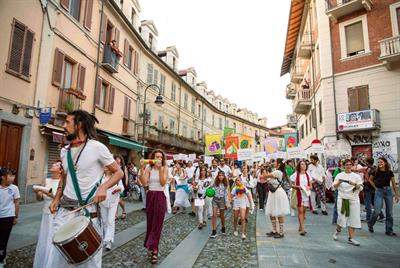
This Special Issue originates from the Horizon Europe project “Democracy in Action” which serves as its conceptual and practical starting point. The practice-based research project explores how arts and culture-based grassroots organizations—both in physical spaces and across metaverse environments—can foster democracy, participation and civic engagement. The project investigates how grassroots cultural practices generate critical spaces for political expression and inclusion in four key areas: nightivism (urban night time cultural life for political engagement), women’s rights mobilization, ethnic civic participation through cultural expression, and youth activism and civic education. Through a transnational network of pilot organisations (spanning Central Europe, Southern Europe, the Balkans and extending to countries in South America and Africa) the project aims at mapping diverse grassroots practices and examines their organizational models, spatial configurations, funding mechanisms and evaluation processes.
These inquiries resonate with current debates on the cultural commons, which frame grassroots cultural practices as collective processes of governance where cultural policy happens outside institutions; as spaces where cultural rights intersect with other rights; as places where place-related rights (i.e. as the right to the city, the right to nature, and the right to a sustainable and healthy environment) are enhanced. Seen through this lens, “Democracy in Action” provides a living laboratory for exploring how the commons can foster democracy through culture.
Within this context, and responding to UNESCO’s priority on Cultural Rights, we welcome theoretical and empirical contributions that address the following questions and themes:
● Practices and processes: How do grassroots cultural organizations operate? Where and how do they emerge? What environment enables the creation of spaces where communities exercise and expand their rights?
● Interaction and technology: How do these spaces enable new forms of engagement, dialogue and cultural access using or not using technology?
● Flexibility and adaptability: How do grassroots initiatives respond and adapt to local identities, needs and socio-political contexts?
● Evaluation: How to capture and evaluate the social and cultural impact of informal and creative practices using unconventional and value-based methodologies?
● Policy and governance: How can grassroots challenge existing cultural policies and legal frameworks and foster models of participatory governance? How can enabling environments sustain cultural rights, protect artistic and cultural production and reinforce diversity of expression?
● People and places: How do cultural rights intersect with other “place-related” rights, such as the right to the city, the right to a safe, clean, healthy and sustainable environment, and indigenous land rights?
This Special Issue invites contributions from scholars, practitioners and policymakers working in the fields of cultural rights, grassroots democracy and the commons. We will encourage our “Democracy in Action” partners to participate in the Special issue.
Authors are welcome to submit articles presenting original studies or literature review work. Please consult the journal's information regarding Article Types, Author Guidelines, and Publishing Fees. Please contact the Editorial Office at ejcmp@frontierspartnerships.org for any query concerning this initiative.
Even though abstract submission is not mandatory, we encourage all interested researchers to submit a “manuscript summary” before submitting their article. Manuscript summaries do not have to coincide with the final abstract of the article.
We would like to acknowledge Matilde Ferrero and Giulia Avanza who have acted as coordinators and have contributed to the preparation and running of this collection.
Keywords: cultural rights, co-creation, inclusive policy, cultural commons, collective governance, grassroots organisations, commoning practices, right to culture
